


Understand baccarat rules and gameplay. Learn step-by-step how to play, read the table, and practice responsible gaming.

Baccarat Guide – Rules & How to Play
Baccarat is a card game that is renowned for its simplicity and elegance. It has become one of the most popular table games worldwide, particularly in casinos after its origin in Europe. Baccarat is a casino game that does not necessitate sophisticated skill to be enjoyed. It is accessible to novices because players primarily concentrate on placing bets, and comprehending the results. The thrill is derived from the ability to anticipate which hand, the Banker or the Player will have a total that is closest to nine. Additionally, there is the possibility of placing a wager on a tie, which is less probable but offers a higher payout.
The rules of baccarat are often linked to high-stakes play, but they remain straightforward regardless of the amount of money wagered. It is essential to comprehend the mechanics of card totals, the available wagers and the dealer’s management of the game in order to engage in baccarat responsibly.

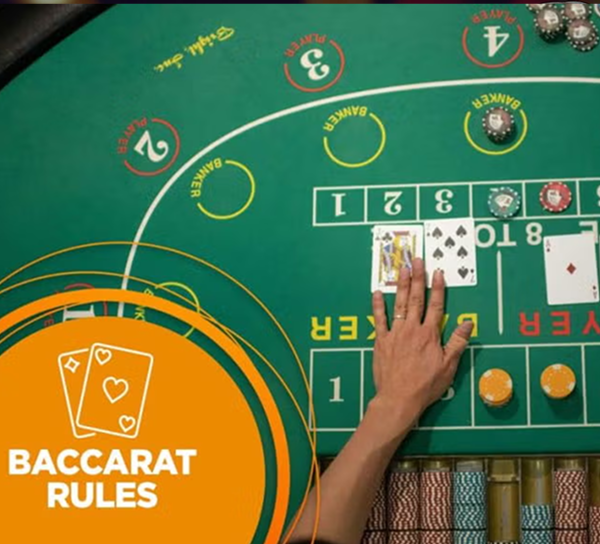
Baccarat employs multiple decks of cards, typically six or eight, that are shuffled together. Each card is valued in a straightforward manner:
Each round involves the distribution of two hands: one to the Banker and one to the Player. Players wager on the hand they believe will emerge victorious or on the possibility of a tie at the conclusion of the round. The dealer distributes two cards to each hand following the placement of wagers. The hand that achieves the closest total to nine is the winner. If both hands are tied, the wagers on the Tie win, while the bets on the Player and Banker lose.
The value of the two cards is added to determine the baccarat total. The final digit is the only digit that is considered if the sum exceeds 9. For instance, a hand that contains a 7 and an 8 results in a total of 15, which is equivalent to 5.
Predetermined guidelines, are the foundation of the third card’s automatic rules:
The Banker’s draw is contingent upon the Banker’s total, and the Player’s third card.


The gambler's fallacy is the conviction that past results have an impact on future outcomes.
Impulsively altering wager sizes in response to victories or defeats.
Confusing Baccarat with other card games such as Punto Banco, or Chemin de Fer, which have minor rule differences.
Disregarding the minimums and maximums of the table.
Concentrating solely on luck without comprehending fundamental principles and probabilities.

However, simplicity can be deceptive as evidenced by Baccarat. The objective of the game is to provide entertainment, not to generate revenue. It is imperative that participants establish boundaries regarding their time and financial resources, and they should also take breaks to preserve their perspective. Engage in the game by learning it and observing the process rather than concentrating solely on victory.